Almost every SaaS tool today has an "AI feature". In practice, it is almost always the same thing: a chatbot in a corner of the screen. It is locked to the model the supplier has chosen for you, it can only do what is already built in, and it can rarely write anything for real - just read and respond.MCPis the answer to all three constraints.
What MCP actually is
MCP stands forModel Context Protocoland is an open standard that lets an AI assistantcall tools and read resources in an external system over a single connection.Think of it as a standard socket: when a system has an MCP socket, any MCP-compatible AI can plug in and work – without custom-built integration for each model.
MCP reverses the relationship between platform and AI
The usual model is that the platform embedsitsAI. The MCP inverts it: the platform exposesitselffor that AIyouchooses. It solves three structural problems with native chatbots:
No supplier lock-in.You choose the model yourself, not the supplier.
No cap on ability.The assistant is not limited to what happens to be pre-built.
Actual action.Set up correctly, the AI can write – securely and gated – not just read.
Tools and resources – the two things a connection provides
An MCP clutch offers the AI two things:
tools– actions the AI can perform, for example
sstm_crm_add_contact, with a typed schema detailing exactly which arguments are required.Resources– data the AI can read via a URI, for example
sstm://crm/deals.
Ask an AI to "build a price-card component" and it will first read the design tokens and component conventions via the resources, then create the component via the tools - and the result will be reviewed by a human before it's sharp.
The person in control – every time
The power to write must be gated. In sSystm, all writing is staged aswaitingand require human approval before running, with full trace log in an Agent log. The AI suggests; you decide.
How sSystm uses MCP
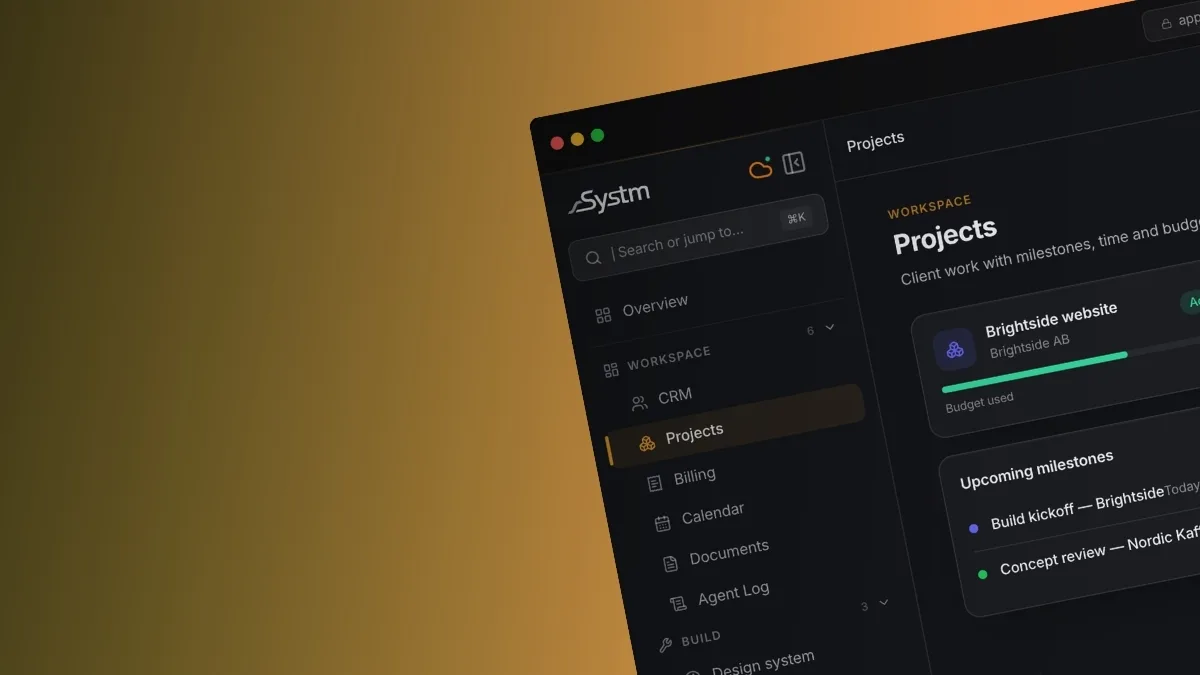
sSystm is built around this idea from the ground up. The platform exposes29 tools and 35 resourcesacross CRM (contacts, deals, companies), projects, design systems, wireframes, documents, calendar and content marketing. The connector works with Claude Desktop, Claude Code, claude.ai, Cursor and other MCP clients – so you bring your own AI into your own workspace.
It fits into a larger idea: in sSystm, your data resides in your own cloud account, and the AI queries that data in your account, under your jurisdiction. Read more inWhat is BYOC?and this springlaunch article.
Want to try it yourself?
sSystm is in private beta and beta participants right now get access to everything - including free AI tokens for the Build module during the beta period. Places are limited.Join the waiting list →