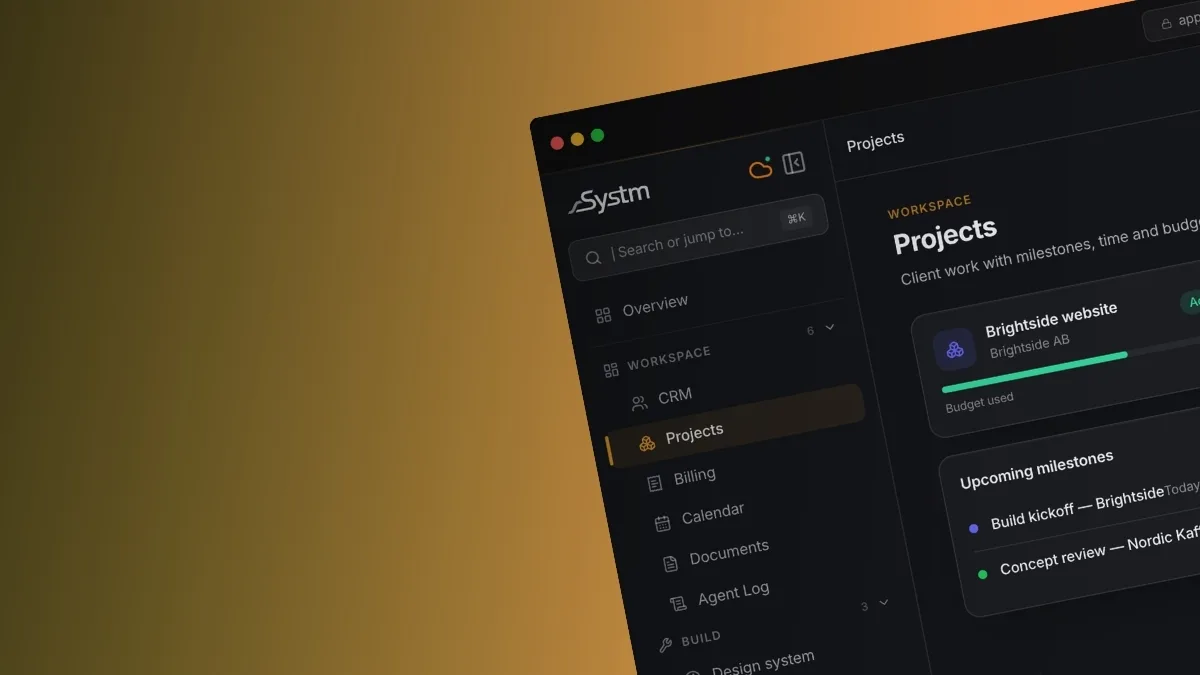
Ask yourself a simple question about the tools your agency uses:where exactly is the customer data?In almost all SaaS, the answer is the same – in the provider's central database, in the same cluster as all other customers' data.BYOCis another way.
What BYOC means
BYOC stands forBring Your Own Cloud. A BYOC agency OS is an all-in-one platform to run an agency thereyour data lives in a database provisioned on your own cloud account, instead of in the provider's central database.
The basic principle: there is no central supplier database. Instead, a dedicated database is created on your cloud account, in the region you choose. The supplier operates the software – but you own the data warehouse. If you disconnect the service, the database is still yours, in your account.
Three problems with regular SaaS that BYOC solves
Aggregate risk.When all data resides in a multi-tenant cluster, a breach can expose all customers simultaneously. With BYOC, there is no central point to break into.
Insecure data residency.Where the data is stored is a policy promise that can be changed. With BYOC, the data is yours "by construction" – it is physically located where you decided.
Exit friction.Leaving regular SaaS means exporting and rebuilding. With BYOC, there is no exit cost – you already have the database.
BYOC compared to SaaS and self-hosting
Property | SaaS | Self-hosting | BYOC |
|---|---|---|---|
Data residency | Supplier Policy | Your choice | Your city construction |
Operating burden | No | All on you | No |
Cost to leave | Export is required | No | No |
BYOC takes the best of both: you don't have to run servers yourself (as in SaaS), but you still own the data and the jurisdiction (as in self-hosting).
How it works with Cloudflare
In sSystm, you log in with Cloudflare. The platform then commissions aD1 database in your account, in selected region, with a guaranteed hardEU Jurisdictionas an alternative. When you build apps in the Build module, these Workers are deployed toyour ownaccount - not the supplier's. AI assistants are connected viaMCPand queries the data in your account, under your jurisdiction, using a human-in-control model where actions are staged as pending until you approve.
What it means for GDPR
Data residency becomes stronger for a simple reason: because the database is provisioned in your account, you can lock it to a jurisdiction. You don't have to rely on a promise about where the data isshouldlie - you can point to where it actually lies.
Four questions that reveal true BYOC
Not everyone who says "BYOC" means the same thing. Test a statement against four questions:
Create the database onyoursaccount – or just isolated in the supplier's?
Canthe jurisdiction is lockedwhen provisioning?
When you disconnect: the provider loses access whileyou keep everything?
Also deployedthe code(the compute artifacts) to your account?
sSystm answers yes to all four. More about the entire platform this springlaunch article.
BYOC already exists – but not as an office Olympics
BYOC as a deployment model is not new. But until now it has been exclusively aboutinfrastructure: platforms like Northflank, Aiven and Railway run databases, containers or test environments on your cloud account. sSystm is the first to take the whole idea all the way to a complete operating system for agencies and developers - CRM, projects, invoicing, documents, marketing and AI, all BYOCby design. That's why we call it the world's first BYOC agency Olympics.
Want to truly own your data?
sSystm is the world's first BYOC agency OS and is currently opening a private beta. Beta participants get access to everything during the beta and 12 months ahead, plus free AI tokens for Build. Places are limited.Join the queue →
Source
What is a BYOC agency OS?(sSystem)